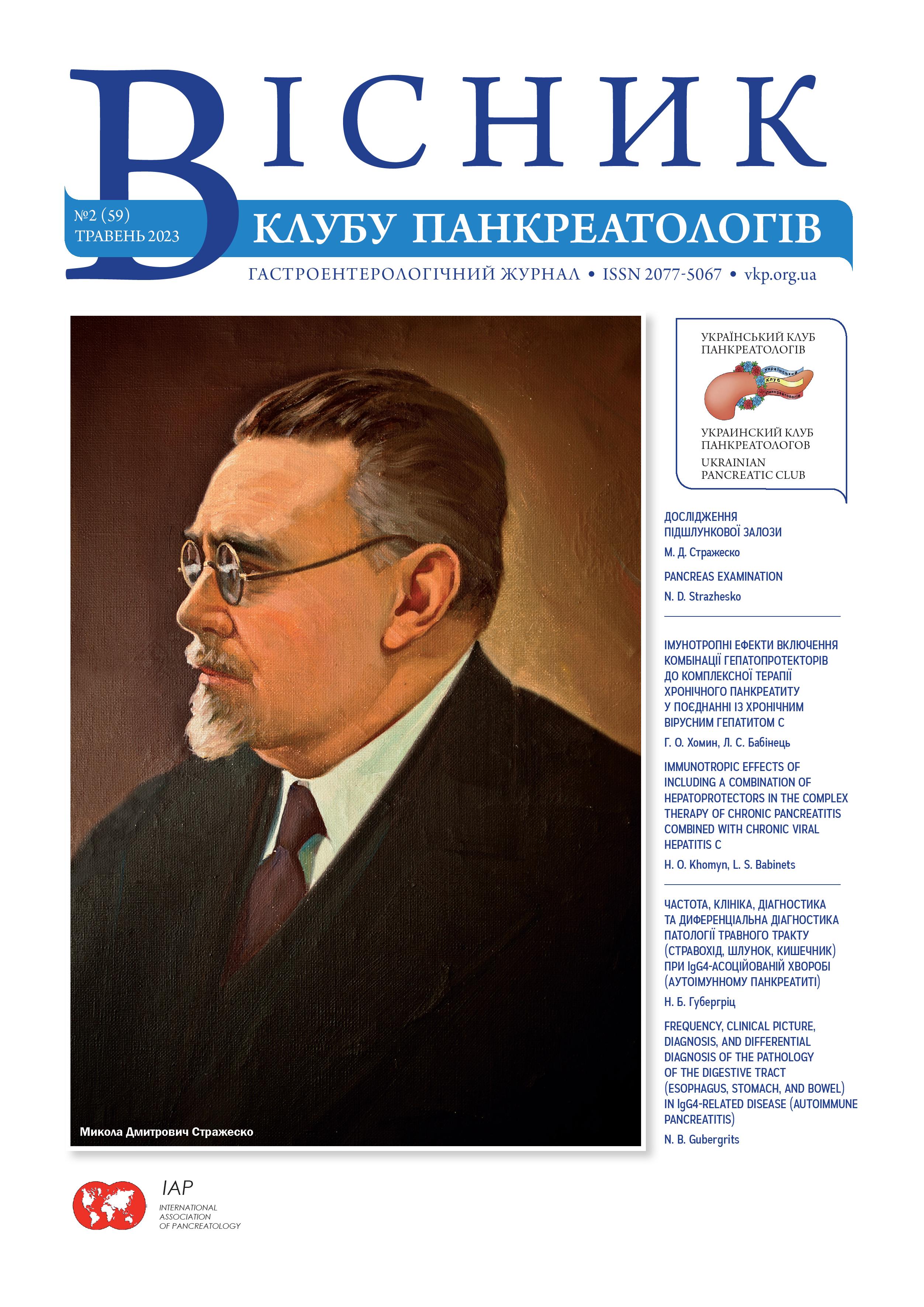
Keywords
How to Cite
Abstract views: 208 PDF Downloads: 209
Abstract
Among significant etiological factors contributing to chronic pancreatitis (CP), the infectious factor plays a role in 56.88% of patients and the hepatobiliary factor in 44.50%, which has drawn attention to the particular importance of these factors. Hepatitis C virus (HCV) is the most common and important viral agent that causes or worsens CP. HCV is not only a disease of the liver but also a systemic (generalized) infection that involves other organs, in particular the pancreas and the immune system.
The aim is to study the state of the cellular and humoral immune systems of patients with CP against the background of treated chronic HCV (CHCV) under the influence of the proposed complex treatment with the additional inclusion of hepatotrophic drugs heparizine (HZ) and metadoxine (MD).
Materials and methods. We examined 80 patients with a combined course of CP and CHCV. According to the methods of treatment, the patients were divided into 3 groups: group 1 (20 patients with CP and CHCV) received the generally accepted complex of protocol treatment (PT) for three months; group 2 (25 patients with CP and CHCV) received PT with the additional inclusion of the hepatotrophic agent Heparizine PLC 1 capsule 3 times a day after meals for 3 months; and group 3 (35 patients with CP and CVHC with CAGE ≥2.0) received PT with the additional inclusion of the hepatotrophic agent Heparizine PLC (one capsule) 3 times a day after meals for 3 months with the addition of MD (Liveria IS) 500 mg (one tablet) 2 times a day 15–30 min before meals for 3 months.
Results and discussion. With the additional administration of HZ, a higher dynamics of cellular immunity indices was reached in relation to those in the PT group. When using a combination of HZ and MD, even better results were obtained in the dynamics of the following indices: an increase in the total population of T-lymphocytes by 5.2%, 22.9%, and 57.7% in groups 1–3, respectively; NK cells — by 13.1%, 23.0%, and 39.4%; T-helpers — by 10.7%, 22.8%, and 36.3%; T-suppressors — by 26.0%, 38.9%, and 45.3%; a decrease in the number of B-lymphocytes — by 10.4%, 18.9%, and 35.6%. An increase in the immunoregulatory index (CD4/CD8) was also achieved — by 11.5%, 17.7%, and 45.7%. The decrease in the levels of B-lymphocytes under the influence of treatment in all three groups was accompanied by a decrease in the activation of humoral factors in groups 1–3, respectively: a decrease in the content of IgG in blood serum by 8.7%, 15.5%, and 19.2%; IgA — by 21.8%, 70.2%, and 88.5%; and IgM — by 24.0%, 55.5%, and 84.9%; as well as a significant decrease in the levels of circulating immune complexes by 38.6%, 1.9 times and 2.9 times (p<0.001).
Conclusion. A positive immunocorrective effect of all three programs of complex treatment was proven, with a significantly higher level of those with the additional inclusion of HZ and especially the combination of HZ and MD in the complex therapy of patients with CP against the background of CHCV treated causally. Based on the results of correcting cellular and humoral immunity as an integral part of nutritional trophological status, it seems reasonable to include the proposed programs to eliminate nutritional and other disorders in people with CP and CHCV.
References
Бабінець Л. С. Ефективність біорегуляційного підходу у комплексній корекції ендогенної інтоксикації при хронічних ураженнях панкреатогепатобіліарної системи. Гастроентерологія. 2020. № 2. С. 84–87.
Бабінець Л. С., Криськів О. І., Шайген О. Р., Хомин Г. О. Аналіз впливу різних етіологічних чинників на виникнення хронічного панкреатиту. Вісник Вінницького держ. мед. університету. 2013. № 7 (2/1). С. 444–445.
Бабінець Л. С., Палихата М. В., Сасик Г. М. Можливості комплексної реабілітації хворих на хронічний панкреатит на етапі первинної медичної допомоги (огляд літератури). Вестник клуба панкреатологов. 2018. № 2 (39). С. 4–11.
Бабінець Л. С., Сасик Г. М. Аналіз функціональної спроможності підшлункової залози при коморбідності хронічного панкреатиту з цукровим діабетом 2-го типу. Сімейна медицина. 2020. № 5–6 (91–92). С. 47–50.
Бабінець Л. С., Сасик Г. М. Оптимізація корекції ентеропанкреатичного синдрому у комплексній реабілітації пацієнтів з хронічним панкреатитом у поєднанні з цукровим діабетом 2 типу. Український терапевтичний журнал. 2020. №2. С. 37–42.
Мостовий Ю. М. (ред.) Сучасні класифікації та стандарти лікування розповсюджених захворювань внутрішніх органів. 21-ше вид. доп. і перероб. Вінниця, 2022. 1011 с.
Abdel Alem S., Elsharkawy A., Fouad R., Adel E., Abdellatif Z., Musa S., Nagy A., Hussein M. S., Yosry A., Esmat G. Improvement of glycemic state among responders to Sofosbuvir‐based treatment regimens: single center experience. J. Med. Virol. 2017. Vol. 89. P. 2181–2187.
Babinets L. S., Sasyk H. M., Halabitska I. M., Mykuliak V. R. Possibilities of complex rehabilitation of patients with type 2 diabetes and concomitant chronic pancreatitis in ambulatory practice. Balneologia. 2021. Vol. 1. P. 12–15.
Babinets L. S., Shaihen O. R., Khomyn H. O., Halabitska I. M. Specific aspects of clinical course in case of combination of chronic pancreatitis and concomitant viral hepatitis C. Wiadomosci lekarskie (Warsaw, Poland: 1960). 2019. Vol. 72, No 4. P. 595–599.
Bitton S., Pettei M. J. Exocrine pancreatic insufficiency. Pediatr. Rev. 2016. Vol. 37, No 2. P. 85–87.
Chevaliez S., Soulier A., Poiteau L., Bouvier-Alias M., Pawlotsky J. M. Clinical utility of hepatitis C virus core antigen quantification in patients with chronic hepatitis C. J. Clin. Virol. 2014. Vol. 61. P. 145–148.
Dominguez-Munoz J. E., Lucendo A., Carballo L. F., Iglesias-Garcia J., Tenias J. M. A Spanish multicenter study to estimate the prevalence and incidence of chronic pancreatitis and its complications. Rev. Esp. Enferm. Dig. 2014. Vol. 106, No 4. P. 239–245.
Drazilova S., Janicko M., Skladany L., Kristian P., Oltman M., Szantova M., Krkoska D., Mazuchova E., Piesecka L., Vahalova V., Rac M. Glucose metabolism changes in patients with chronic hepatitis C treated with direct acting antivirals. Can. J. Gastroenterol. Hepatol. 2018. Vol. 2018. 6095097.
European Association for Study of the Liver. EASL Recommendations on Treatment of Hepatitis C 2015. J. Hepatol. 2015. Vol. 63. P. 199–236.
Foster G. R., Dore G. J., Wang S., Grebely J., Sherman K. E., Baumgarten A., Conway B., Jackson D., Asselah T., Gschwantler M., Tomasiewicz K. Glecaprevir/pibrentasvir in patients with chronic HCV and recent drug use: an integrated analysis of 7 phase III studies. Drug Alcohol. Depend. 2019. Vol. 194. P. 487–494.
Gower E., Estes C., Blach S., Razavi-Shearer K., Razavi H. Global epidemiology and genotype distribution of the hepatitis C virus infection. J. Hepatol. 2014. Vol. 61. P. S45–57.
Hagstrom H. Alcohol consumption in concomitant liver disease: how much is too much? Curr. Hepatol. Rep. 2017. Vol. 16. P. 152–157.
Indolfi G., Easterbrook P., Dusheiko G., El-Sayed M. H., Jonas M. M., Thorne C., Bulterys M., Siberry G., Walsh N., Chang M. H., Meyers T. Hepatitis C virus infection in children and adolescents. Lancet Gastroenterol. Hepatol. 2019. Vol. 4. P. 477–487.
Levy P., Dominguez-Munoz E., Imrie C., Löhr M., Maisonneuve P. Epidemiology of chronic pancreatitis: burden of the disease and consequences. United European Gastroenterol. J. 2014. Vol. 2, No 5. P. 345–354.
Lew D., Afghani E., Pandol S. Chronic pancreatitis: current status and challenges for prevention and treatment. Dig. Dis. Sci. 2017. Vol. 62, No 7. P. 1702–1712.
Löhr J. M., Oliver M. R., Frulloni L. Synopsis of recent guidelines on pancreatic exocrine insufficiency. United European Gastroenterol. J. 2013. Vol. l, No 2. P. 79–83.
Nahon P., Bourcier V., Layese R., Audureau E., Cagnot C., Marcellin P., Guyader D., Fontaine H., Larrey D., De Lédinghen V., Ouzan D. Eradication of hepatitis C virus infection in patients with cirrhosis reduces risk of liver and non-liver complications. Gastroenterology. 2017. Vol. 152. P. 142–156, e2.
Razavi H., Robbins S., Zeuzem S., Negro F., Buti M., Duberg A. S., Roudot-Thoraval F., Craxi A., Manns M., Marinho R. T., Hunyady B. Hepatitis C virus prevalence and level of intervention required to achieve the WHO targets for elimination in the European Union by 2030: a modelling study. Lancet Gastroenterol. Hepatol. 2017. Vol. 2. P. 325–336.
Soulier A., Poiteau L., Rosa I., Hézode C., Roudot-Thoraval F., Pawlotsky J. M., Chevaliez S. Dried blood spots: a tool to ensure broad access to hepatitis C screening, diagnosis, and treatment monitoring. J. Infect. Dis. 2016. Vol. 213. P. 1087–1095.
Younossi Z. M., Zheng L., Stepanova M., Venkatesan C., Mir H. M. Moderate, excessive or heavy alcohol consumption: each is significantly associated with increased mortality in patients with chronic hepatitis C. Aliment. Pharmacol. Ther. 2013. Vol. 37. P. 703–709.